
November 05, 2026 | Dr. Jeffrey Roach
The artificial intelligence (AI) investment boom is beginning to leave a clear imprint on U.S. trade, computer inflation, and the labor market as highlighted in our recent Econ Market Minute.
The trade deficit subtracted 3.3 percentage points from Q3 economic growth. Excluding “Liberation Day” distortions, last quarter’s negative impact was the largest since 1947!
In this piece, I explain why the trade deficit has widened so dramatically. American technology companies are pouring capital into data centers and computing capacity, but much of the physical equipment needed to build that infrastructure is produced abroad. Servers, semiconductors, storage systems, networking equipment, and other advanced electronics are increasingly flowing into the U.S., creating an unusual dynamic: an investment boom largely driven by American companies is becoming an important source of demand for manufacturers outside the U.S.
AI has become one of international trade’s principal drivers. And this happened despite formidable trade barriers. The average U.S. tariff rate rose from 2.9% in January 2025 to 14.8% by December. Dallas Federal Reserve (Fed) researchers estimate that, all else equal, the increase in tariffs would have reduced U.S. imports by approximately 12%. Some of the resilience reflected companies rushing imports ahead of tariffs, but booming AI investment was another important counterweight. Demand for computing equipment has simply been strong enough to overcome some of the drag from substantially higher trade barriers.
The AI Buildout is Drastically Reshaping International Trade
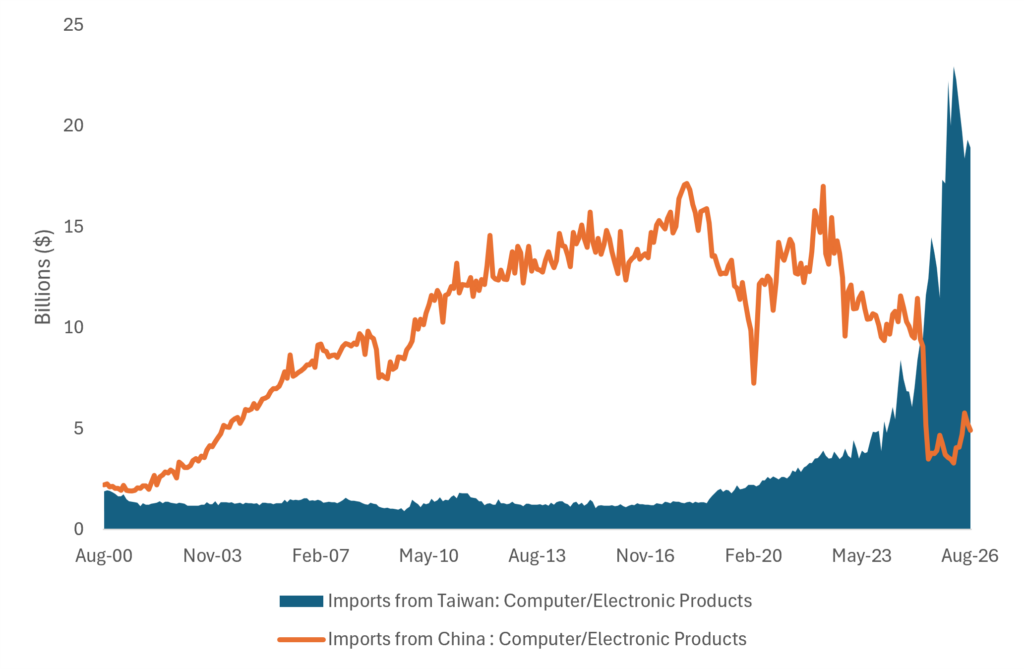
Source: LPL Research, Census Bureau 11/04/26
Disclosures: Past performance is no guarantee of future results.
The AI boom is also changing where America buys its goods. China’s share of U.S. imports fell from 13.4% in 2024 to 9% in 2025, while countries including Taiwan, Mexico, Vietnam, and India gained ground. Growth in technology imports from Taiwan and Mexico has substantially exceeded the decline from China, suggesting the pattern reflects more than a simple reshuffling of existing trade. It represents new demand alongside the reorientation of global supply chains.
Taiwan occupies a particularly important position because of its role in advanced semiconductors and computing. Mexico’s growing role tells a different, but complementary, story. Much of the computing equipment used in U.S. data-center construction has been imported through Mexico, according to the Dallas Fed, reinforcing the country’s position inside North America’s technology manufacturing hub.
There is even evidence that AI demand is spilling into prices. Heavy demand for memory chips used in data centers has helped push consumer-electronics prices higher, reversing their decades-long tendency to decline. That underscores the scale of the investment cycle: AI infrastructure is competing for some of the same technology components used elsewhere in the economy.
The International Investment Angle
For investors, these changing trade patterns broaden the AI story beyond the familiar group of U.S. technology companies. American hyperscalers may be writing many of the checks for new data centers, but an expanding portion of the manufacturers are overseas.
That creates an important argument for international diversification that goes beyond cheaper valuations. Taiwan offers exposure to semiconductors and advanced-computing supply chains. Mexico is becoming more deeply integrated into North American technology manufacturing. Vietnam, India, and other Asian economies are gaining share as global supply chains continue to diversify away from China.
There is an interesting macroeconomic twist. Imports subtract from U.S. gross domestic product (GDP) accounting, so the AI infrastructure boom can widen the trade deficit and weigh down U.S. growth even while signaling strong underlying business investment. At the same time, American investment can support production, capital spending and incomes in countries supplying the equipment.
For investors heavily concentrated in U.S. equities, that is worth considering. AI may be led, and financed by America, but the economic benefits are increasingly global. The next stage of the AI investment cycle may create opportunities not only among the companies designing models and operating data centers, but also among the international companies and economies supplying the semiconductors and electronics needed.
Important Disclosures
This material is for general information only and is not intended to provide specific advice or recommendations for any individual. There is no assurance that the views or strategies discussed are suitable for all investors. To determine which investment(s) may be appropriate for you, please consult your financial professional prior to investing.
Investing involves risks including possible loss of principal. No investment strategy or risk management technique can guarantee return or eliminate risk.
Indexes are unmanaged and cannot be invested into directly. Index performance is not indicative of the performance of any investment and does not reflect fees, expenses, or sales charges. All performance referenced is historical and is no guarantee of future results.
This material was prepared by LPL Financial, LLC. All information is believed to be from reliable sources; however LPL Financial makes no representation as to its completeness or accuracy.
Unless otherwise stated LPL Financial and the third party persons and firms mentioned are not affiliates of each other and make no representation with respect to each other. Any company names noted herein are for educational purposes only and not an indication of trading intent or a solicitation of their products or services.
Asset Class Disclosures –
International investing involves special risks such as currency fluctuation and political instability and may not be suitable for all investors. These risks are often heightened for investments in emerging markets.
Bonds are subject to market and interest rate risk if sold prior to maturity.
Municipal bonds are subject and market and interest rate risk and potentially capital gains tax if sold prior to maturity. Interest income may be subject to the alternative minimum tax. Municipal bonds are federally tax-free but other state and local taxes may apply.
Preferred stock dividends are paid at the discretion of the issuing company. Preferred stocks are subject to interest rate and credit risk. They may be subject to a call features.
Alternative investments may not be suitable for all investors and involve special risks such as leveraging the investment, potential adverse market forces, regulatory changes and potentially illiquidity. The strategies employed in the management of alternative investments may accelerate the velocity of potential losses.
Mortgage backed securities are subject to credit, default, prepayment, extension, market and interest rate risk.
High yield/junk bonds (grade BB or below) are below investment grade securities, and are subject to higher interest rate, credit, and liquidity risks than those graded BBB and above. They generally should be part of a diversified portfolio for sophisticated investors.
Precious metal investing involves greater fluctuation and potential for losses.
The fast price swings of commodities will result in significant volatility in an investor’s holdings.
This research material has been prepared by LPL Financial LLC.
Not Insured by FDIC/NCUA or Any Other Government Agency | Not Bank/Credit Union Deposits or Obligations | Not Bank/Credit Union Guaranteed | May Lose Value
For Public Use – Tracking: #1204311