
World Cup-onomics 2026: A More Diversified Economic Event
George Smith | Portfolio Strategist
Last Updated: June 11, 2026
The 2026 FIFA Soccer World Cup kicks off today, and it will look very different from prior tournaments, not just on the field, but economically.
For the first time, this event will be hosted across three countries: the United States, Mexico, and Canada. That structure shifts the World Cup from a concentrated investment into something closer to a diversified portfolio. Instead of one country absorbing the full cost and risk, exposure is spread across multiple economies, currencies, and cities.
Just as importantly, this will be the first soccer World Cup since 1994 to rely almost entirely on existing stadium infrastructure. That marks a sharp departure from recent tournaments, where large-scale construction drove costs. In 2026, the focus shifts from capital expenditure to utilization — layering incremental demand onto assets that already exist.
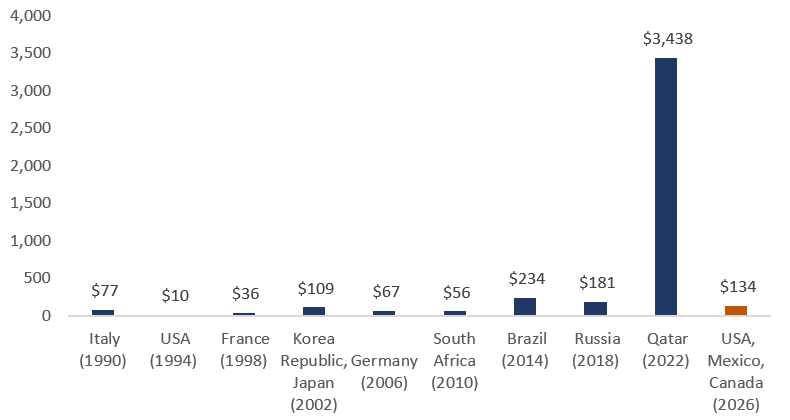
While the overall impact to the U.S. economy (given its immense size) is expected to be fairly negligible (0.05%), the utilization of existing assets materially lowers the bar for economic success. While the tournament is still expected to cost roughly $13.9 billion, it remains far below levels seen in recent cycles and significantly reduces the risk of underutilized “white elephant” stadium projects.
Cost Per Game to Host Soccer World Cup (millions U.S.$)
Source: LPL Research, FIFA.com 06/01/26
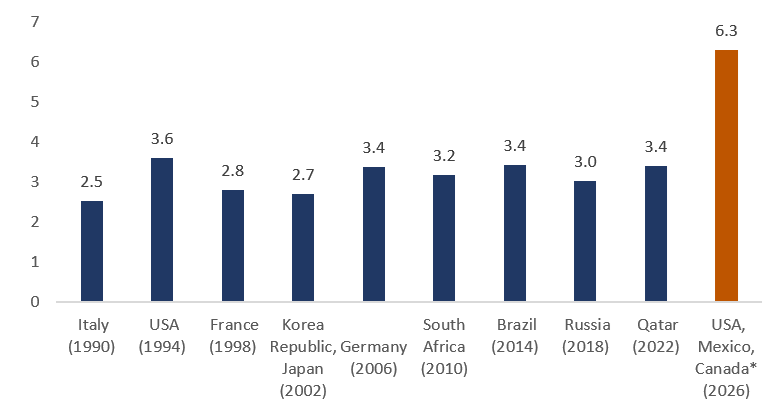
At the same time, the expanded 48-team format increases the scale of the event. The number of matches rises from 64 to 104, with total attendance expected to exceed six million, both record highs, with stratospheric ticket prices to match.
Total Fan Attendance at Soccer World Cups (millions of fans)
Source: LPL Research, Statista.com 06/01/26
*Estimated based on stadium capacities
The result is a more distributed and nuanced economic impact. Benefits will likely accrue unevenly across cities, industries, and regions rather than showing up clearly at the national level.
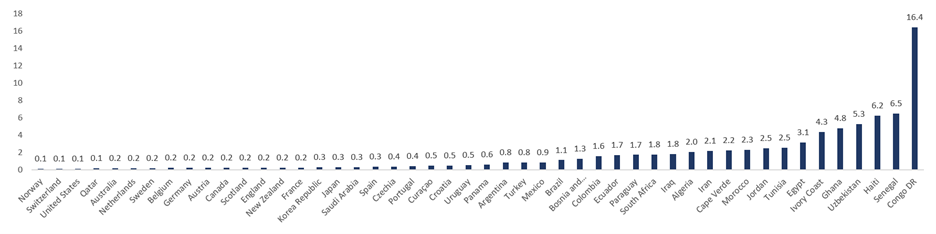
The economics of the 2026 World Cup are also apparent in ticket pricing. Final tickets were initially priced at over $4,000, with premium seats exceeding $10,000 — a sharp increase from prior tournaments. What stands out is not just the absolute price, but the relative affordability across countries. When scaled by income, the cost of attending a final varies dramatically. In higher-income economies, a ticket represents a fraction of annual earnings. In lower-income participating countries, it can equate to multiple years of income (with Congo DR being the outlier at over 16 years of income required for a single ticket) highlighting a significant disparity in access to what is nominally a global event. This dynamic reinforces a broader theme: while the World Cup is global in reach, the economic experience of it is far from uniform.
How Many Years Work to Afford a World Cup Final Ticket
World Cup final cost divided by gross national income (GNI)
Source: LPL Research, FIFA.com, World Bank 06/01/26
GNI per capita data using Atlas Method, current U.S. $, latest available data 2024.
For investors, the takeaway is straightforward: diversification may reduce downside risk, but it also can diffuse potential upside. The 2026 World Cup reflects that tradeoff, less concentrated, more complex, and ultimately more difficult to measure at a national level.
Good luck to our advisors, clients, and all soccer fans whoever you support!
Check out the full update to our World Cup-onomics report, including detailed group-by-group previews, economic comparisons across all 48 nations, and model-based simulated results for both the group stage and knockout rounds. The expanded format introduces greater dispersion across outcomes, both on the pitch and across markets, and provides a unique lens through which to analyze global economic contrasts at scale.
There is no guarantee that a diversified portfolio will enhance overall returns or outperform a non-diversified portfolio. Diversification does not protect against market risk.
Important Disclosures
This material is for general information only and is not intended to provide specific advice or recommendations for any individual. There is no assurance that the views or strategies discussed are suitable for all investors. To determine which investment(s) may be appropriate for you, please consult your financial professional prior to investing.
Investing involves risks including possible loss of principal. No investment strategy or risk management technique can guarantee return or eliminate risk.
Indexes are unmanaged and cannot be invested into directly. Index performance is not indicative of the performance of any investment and does not reflect fees, expenses, or sales charges. All performance referenced is historical and is no guarantee of future results.
This material was prepared by LPL Financial, LLC. All information is believed to be from reliable sources; however LPL Financial makes no representation as to its completeness or accuracy.
Unless otherwise stated LPL Financial and the third party persons and firms mentioned are not affiliates of each other and make no representation with respect to each other. Any company names noted herein are for educational purposes only and not an indication of trading intent or a solicitation of their products or services.
Asset Class Disclosures –
International investing involves special risks such as currency fluctuation and political instability and may not be suitable for all investors. These risks are often heightened for investments in emerging markets.
Bonds are subject to market and interest rate risk if sold prior to maturity.
Municipal bonds are subject and market and interest rate risk and potentially capital gains tax if sold prior to maturity. Interest income may be subject to the alternative minimum tax. Municipal bonds are federally tax-free but other state and local taxes may apply.
Preferred stock dividends are paid at the discretion of the issuing company. Preferred stocks are subject to interest rate and credit risk. They may be subject to a call features.
Alternative investments may not be suitable for all investors and involve special risks such as leveraging the investment, potential adverse market forces, regulatory changes and potentially illiquidity. The strategies employed in the management of alternative investments may accelerate the velocity of potential losses.
Mortgage backed securities are subject to credit, default, prepayment, extension, market and interest rate risk.
High yield/junk bonds (grade BB or below) are below investment grade securities, and are subject to higher interest rate, credit, and liquidity risks than those graded BBB and above. They generally should be part of a diversified portfolio for sophisticated investors.
Precious metal investing involves greater fluctuation and potential for losses.
The fast price swings of commodities will result in significant volatility in an investor’s holdings.
This research material has been prepared by LPL Financial LLC.
Not Insured by FDIC/NCUA or Any Other Government Agency | Not Bank/Credit Union Deposits or Obligations | Not Bank/Credit Union Guaranteed | May Lose Value
For Public Use – Tracking: #1120567